- B-152, Mayapuri Industrial Area
- Email us: plassteze@plassteze.com
- Home
- About Us
- Products
- Blog
- Gallery
- Contact
Plassteze supplies a complete range of mould polishing equipment and consumables for die and mould surface finishing across India. Our range includes the Motosonic ultrasonic polishing machine, micromotor polishing machines, flexible shaft polishing machines and a full line of air tools: air grinders (also called pneumatic grinders), turbo air lappers, swing air lappers and reciprocating handpieces. Whether you need a polisher for ribs and slots, a lapping machine for flat surfaces, or an air grinder for fast stock removal, pair it with world-class polishing consumables sourced from Germany and Japan for mirror-quality finishing.
Every finishing job needs a different tool. Here is how the Plassteze range fits together.
The Motosonic ultrasonic polishing machine polishes ribs, deep slots, intricate shapes and other hard-to-reach areas of moulds and dies. One controller runs the ultrasonic handpiece (22.6 kHz, 45 µm stroke) and micromotor-based rotary and reciprocating handpieces, so a single unit covers deburring, EDM scale removal and fine polishing. A built-in safety circuit protects against overheating and overloading.
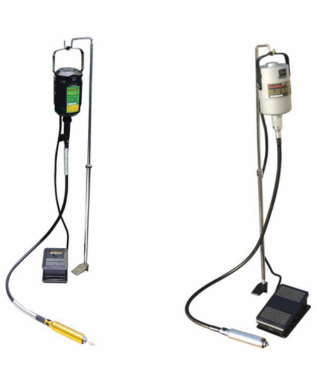
Micromotor polishing machines such as the MULTI 600 (brushless, up to 50,000 rpm, digital speed display, variable-speed pedal) give low-vibration, precise rotary polishing for detailed finishing. Flexible shaft polishing machines are heavy-duty polishers with a reversible motor, low noise and a choice of handpieces. The inner liner of the flexible shaft can be replaced in about a minute.
Plassteze air grinders, also called pneumatic grinders, are quick and economical tools for heavy and fast stock removal, deburring, chamfering and finishing welded surfaces. Choose silent precision models at 60,000 rpm with 3 mm collets, dual-collet 3 mm and 6 mm models for heavy-duty work, 135° and 90° angle grinders, and larger grinders with 6 mm collets such as the DG32M.
Air lappers are compressed-air reciprocating handpieces for lapping, filing and polishing. The UTR-30 (0.3 mm stroke) and UTR-70 (0.7 mm stroke) turbo air lappers are driven by a turbine air motor with low noise, low vibration and long tool life. The US-200 swing air lapper (2.0 mm side-to-side stroke) suits larger surfaces and die-casting parts, and the FPD/R reciprocating handpiece offers an adjustable 0 to 6 mm stroke.
The wider air tools range also includes angle surface grinders, 2-inch air sanders, belt sanders, air saws and air nippers, so one supplier can equip the whole die shop.
Tell us your mould material, the area to be polished and the finish you need, and Plassteze will recommend the right polishing machine, air grinder or lapper. Download the Lapping & Polishing catalogue, email plassteze@plassteze.com or call +91-98102-99598.
Plassteze supplies ultrasonic polishing machines (Motosonic), micromotor polishing machines, flexible shaft polishing machines, air grinders, turbo air lappers, swing air lappers and reciprocating handpieces. Together they cover every stage of mould polishing, from heavy stock removal and EDM recast removal to mirror finishing. Matching polishing consumables are available from Germany and Japan.
An ultrasonic polishing machine uses high-frequency vibration of the polishing tool to remove the EDM recast layer and refine ribs, slots and other hard-to-reach areas of moulds and dies. It is faster and more consistent than manual polishing alone. The Plassteze Motosonic is used on plastic moulds, die-casting dies, ceramics, non-ferrous metals and precious metals.
A controller drives an ultrasonic handpiece so the tool oscillates over a very short stroke about 22,600 times a second. The Motosonic runs at 22.6 kHz with a 45 µm stroke. Use light, even pressure with a ceramic stone or diamond file and keep the tool moving, so the surface is levelled evenly and the handpiece is not overloaded.
Motosonic is a versatile Plassteze polishing machine that combines ultrasonic polishing with micromotor-based rotary and reciprocating handpieces on one controller. It was developed in India and has a safety circuit against overheating and overloading. Key specifications: 22.6 kHz frequency, 45 µm stroke, AC 220 V 50/60 Hz input and a 4.5 kg controller.
An air lapper is a compressed-air reciprocating handpiece that moves a diamond file or ceramic stone back and forth over a short stroke to lap, file and polish moulds. It is used on ribs, slots, flat surfaces and intricate areas. Plassteze supplies turbo air lappers (UTR-30, UTR-70), a swing air lapper (US-200) and the FPD/R reciprocating handpiece.
Choose by stroke length. The UTR-30 (0.3 mm stroke, 30,000 spm) suits intricate area lapping. The UTR-70 (0.7 mm, 28,000 spm) suits general-purpose polishing and finishing of moulds and dies. The US-200 swing lapper (2.0 mm side-to-side stroke, 16,000 spm) suits larger surfaces and deburring or chamfering of die-casting parts.
There is no difference. Air grinder and pneumatic grinder are two names for a grinder driven by compressed air instead of an electric motor. Plassteze air grinders range from the UG-500 silent type (60,000 rpm, 3 mm collet) to the DG32M (18,000 rpm, 6 mm collet), plus angle grinders for hard-to-reach areas.
For precision grinding and finishing, choose a high-speed, quiet model such as the UG-500 or GP-260 (60,000 rpm, 3 mm collet). For heavy deburring, chamfering and milling, choose the UG-300 dual collet (35,000 rpm, 3 mm and 6 mm collets) or the PLA 468 ECON (30,000 rpm). For tight corners, use an angle grinder such as the MAG-121N (135°, 52,500 rpm).
Each tool has its own air requirement, so check the model's specification before sizing a compressor. For example, the FPD/R reciprocating handpiece needs 4 bar (57 psi) and about 65 LPM at 8,000 rpm. Fit a filter and regulator in the air line, and make sure the compressor can sustain the tool's air consumption during continuous work.
Air grinders are light, compact and very fast, which suits heavy stock removal, deburring and quick finishing, but they need a compressed-air supply. Micromotor and flexible shaft polishing machines run on electricity with variable speed control and low vibration, which suits detailed, precise polishing. Many tool rooms use both.
A grinder removes stock quickly using abrasive wheels or burrs at high rpm. A polisher (polishing machine) refines the surface with stones, felt bobs and compounds, in rotary or ultrasonic form. A lapper moves a stone or diamond file back and forth over a short stroke for controlled finishing in ribs, slots and flat areas. Plassteze supplies all three.
Match the machine to the task. Use an air grinder for fast stock removal, an ultrasonic polishing machine for EDM recast and tight ribs, an air lapper for slots and flat surfaces, and a micromotor or flexible shaft polishing machine for final fine polishing with felt bobs and diamond compound. Send Plassteze your mould material and finish requirement for a recommendation.
Ceramic stones and diamond files are the usual choice for ultrasonic polishing machines and air lappers, followed by felt bobs and diamond compounds for final finishing. Air grinders accept flap wheels, abrasive mounted points and felt bobs. Plassteze supplies polishing consumables from Germany and Japan to match each machine.
A mirror finish on injection moulds needs a systematic polishing sequence: start with coarser stones (180 to 400 grit) to remove the EDM recast layer, progress through finer stones (600 to 1500 grit), and finish with diamond compounds (3 µm, 1 µm, 0.25 µm) applied on felt bobs.
The price depends on the model, handpiece options and accessories, so Plassteze quotes on request. Send your application and finish requirement to plassteze@plassteze.com or call +91-98102-99598, and we will recommend the right Motosonic set-up and send a quote.
Plassteze supplies mould polishing equipment, air tools and consumables from offices in New Delhi, Pune, Chennai and Gujarat. Email plassteze@plassteze.com or call +91-98102-99598, and download the Lapping & Polishing catalogue from any product page.
Related reading: Why Every Toolroom Needs a Mould Polishing Machine? | Top 5 Mistakes to Avoid While Using a Mould Polishing Machine | World Class Polishing Consumables
Founded in 2006, Plassteze has established itself as a trusted name in the die and mould industry. With a strong focus on delivering robust, high-performance machines, we aim to simplify and elevate the die and mould making process.