
The Ultimate Guide to Cleaning Injection Mould Cooling Lines: Fixing Cycle Time Losses Caused by Scale and Rust
Cycle times creeping up. Part-to-part temperature inconsistency. Sink marks appearing on components that ran clean six months ago. If any of this sounds familiar, the root cause is very likely sitting inside your cooling channels, not on your machine's control panel. Scale, rust, and biological deposits building up inside mould cooling lines are among the most under-diagnosed causes of productivity loss in injection moulding and HPDC toolrooms across India. The fix isn't a new mould — it's a disciplined cooling line descaling and flushing protocol, backed by the right equipment.
Why Cooling Channels Fail Silently
Every injection mould and die-casting die relies on a network of drilled cooling channels through which water, glycol, or heat-transfer oil circulates to pull heat out of the cavity on every cycle. These channels work under continuous thermal cycling — hot during injection and packing, rapidly cooled during the dwell phase, thousands of times a day.
That constant hot-cold alternation, combined with dissolved minerals in the coolant, creates ideal conditions for scale formation on the inner wall of the channel. Where water quality is poor or coolant is left stagnant during shutdowns, rust and biological slime compound the problem.
The mechanism is straightforward heat transfer physics:
- Steel has a thermal conductivity of roughly 45-50 W/m·K.
- Calcium carbonate scale conducts heat at approximately 2-3 W/m·K.
- Rust and biofilm layers perform even worse, often below 1 W/m·K.
Even a thin scale layer — as little as 0.5mm — can reduce heat transfer efficiency by 20-40% at that section of the channel. As deposits build, the effective channel diameter shrinks, flow velocity drops, and eventually partial or total blockage occurs.
What This Actually Costs You on the Shop Floor
Toolroom managers rarely see "scaled cooling channel" on a defect report. Instead, they see these downstream symptoms:
- Extended cooling time added manually to the cycle — often the single biggest hidden cycle time loss in a moulding shop
- Warpage and dimensional drift from uneven cooling across the cavity
- Sink marks and surface defects on cosmetic parts
- Rising reject rates wrongly attributed to material batch variation
- Premature mould component wear from dies running hotter overall
- Unplanned downtime when a channel finally blocks completely, usually mid-production run
For high-cavitation moulds and HPDC dies running continuous multi-shift production, even a 10% degradation in cooling efficiency can translate into thousands of lost cycles a month.
Chemical Descaling vs. Mechanical Cleaning
Mechanical Cleaning — flexible rotary brushes, high-pressure jetting, or channel rodding — physically dislodges loose scale. It works for accessible, straight-drilled channels but struggles with baffle/bubbler circuits, tight-radius cross-drilled channels, and hardened deposits that have crystallised onto the steel.
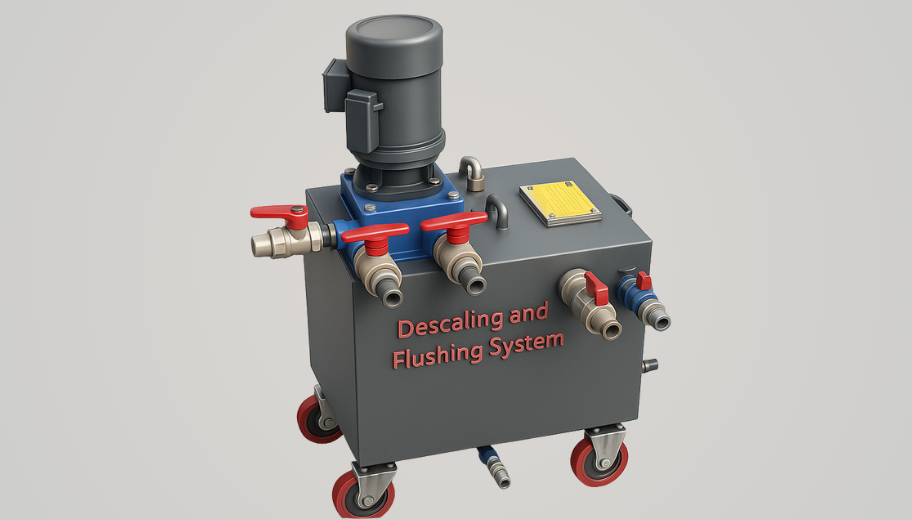
Chemical Descaling & Flushing circulates a controlled, timer-monitored solution through the closed cooling circuit, dissolving scale and rust without disassembly. It reaches inaccessible geometries, is non-invasive, and — with proper temperature and dwell control — leaves the parent steel unaffected while stripping only the deposit layer.
Standard chemical descaling procedure:
- Isolate the mould's cooling circuit from the central chiller/TCU loop
- Connect the descaling unit's supply and return lines to the channel inlet/outlet fittings
- Circulate a pre-heated, dosed descaling solution through the circuit at controlled flow rate
- Hold circulation for the timer-set dwell period based on deposit severity, not guesswork
- Auto cut-off heating maintains solution temperature within the safe working band throughout the cycle
- Flush thoroughly with clean water to neutralise and remove residual chemical
- Pressure-test the circuit to confirm flow has been restored to baseline
- Log flow rate, pressure drop, and cycle parameters against the mould's maintenance record
Timer-controlled, auto cut-off heater design matters more than most buyers realise. Manual descaling — where an operator eyeballs dwell time and temperature — is the biggest cause of either under-cleaning or over-exposure that degrades O-rings and fittings.
Building a Preventive Descaling Schedule
- High-cavitation, high-volume moulds: descale on a fixed interval (every 3-6 months) regardless of visible symptoms
- Hard water regions / non-treated coolant loops: shorten the interval
- Critical/high-value dies: pair scheduled descaling with periodic flow-rate verification
- All moulds: log baseline flow rate and pressure at commissioning for future comparison
Troubleshooting Reference
| Symptom Observed | Likely Root Cause | Recommended Action |
|---|---|---|
| Cycle time increasing over weeks, no process change | Progressive scale buildup | Schedule chemical descaling; verify flow rate before/after |
| Localised sink marks / warpage, same area every shift | Channel-specific blockage | Isolate affected channel; targeted descaling and flow test |
| Coolant discoloured (brown/orange) on drain-down | Rust inside channels/lines | Full circuit flush + corrosion-inhibited coolant going forward |
| Coolant with visible slime or odour | Bacterial/algae biofilm | Chemical flush with biocide-compatible cycle |
| Sudden pressure spike on TCU/chiller pump | Partial or full blockage | Immediate isolation and descaling |
| Rising reject rate blamed on material batch | Uneven mould temperature | Audit cooling flow before adjusting process parameters |
The Equipment Difference: Why Timer-Controlled, Auto Cut-Off Systems Matter
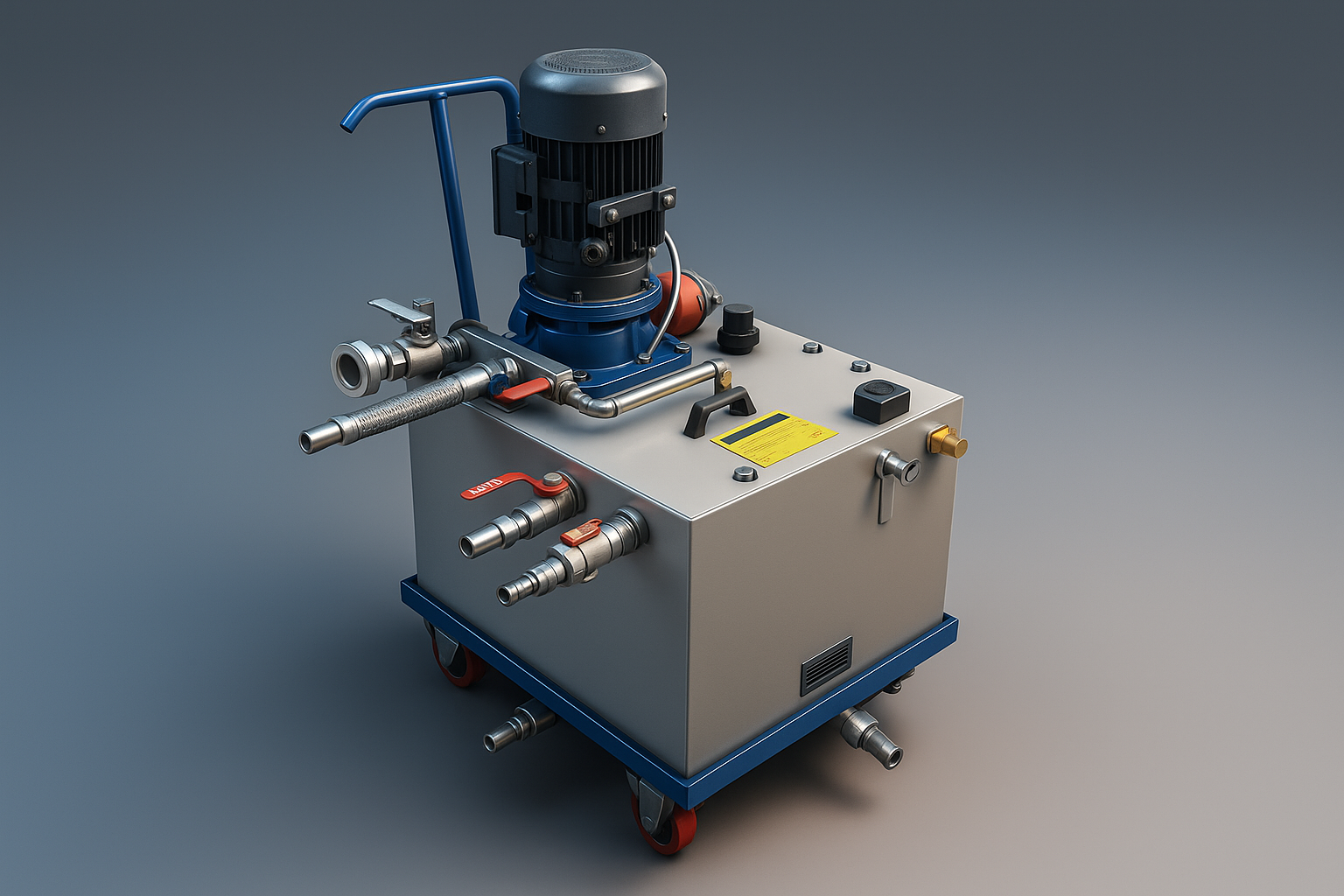
Plassteze's Descaling & Flushing System (DSP25) is built around exactly this logic: a high-output pump engineered to clear stubborn scale, rust, and deposit buildup from cooling channels in injection moulds, HPDC dies, heat exchangers, and industrial boiler/plumbing circuits, controlled by a timer-and-heater system that keeps the process safe, repeatable, and technician-independent. For toolrooms running multi-shift production where cooling efficiency directly drives cycle time and part quality, that repeatability is the difference between a maintenance routine and a guessing game.
If unexplained cycle time drift, rising rejects, or ageing tooling are costing you production hours, the fix is rarely a new mould — it's restoring the cooling circuit you already have to its designed performance.
Frequently Asked Questions (FAQs)
- What does a descaling and flushing system do?
It removes internal buildup of scale, rust, and sludge from cooling lines inside moulds and dies, restoring smooth water flow and heat transfer efficiency. - Is it safe to use on all types of moulds?
Plassteze's DSP25 system is designed for steel, aluminium, and most mould materials, with timer-controlled operation to prevent excessive chemical contact with cooling channels. - Can I clean the mould without dismantling it?
Yes. The system connects directly to the cooling circuit's inlet/outlet fittings, cleaning the mould in-place. - How often should I descale?
Every 3-6 months for high-cavitation, high-volume moulds, or sooner in hard-water regions — see the preventive schedule above rather than waiting for visible symptoms. - Why choose Plassteze over others?
Plassteze is a trusted leader in die & mould solutions, offering reliable equipment with expert support and long-lasting performance.
Request a technical consultation with Plassteze's team to assess your cooling channel condition and build a descaling schedule suited to your production volume and water quality.