- B-152, Mayapuri Industrial Area
- Email us: plassteze@plassteze.com
- Home
- About Us
- Products
- Blog
- Contact

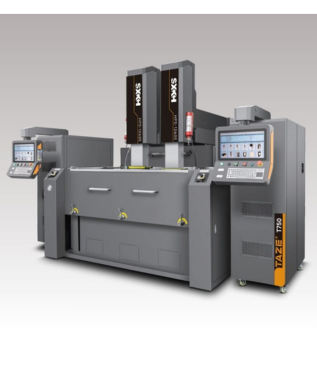
Plassteze's Sinker EDM Machine is engineered for toolrooms that cannot afford rework — delivering mirror-grade 0.01 Ra surface finishes directly off the machine, with a rated machining speed of up to 750 mm³/min that cuts cycle time without compromising dimensional accuracy. Built on an industrial Linux OS with power-off memory protection, it keeps unattended overnight and multi-shift machining runs safe from data loss and copyright-licensing interruptions. For die and mould manufacturers running high-cavity, high-value tooling, this is a machine designed to hold tolerance run after run, not just on the first part off the table.
| Parameter | Specification |
|---|---|
| Table Size (X x Y) | 650 x 450 mm |
| X/Y/Z Axis Travel | 400 / 300 / 300 mm |
| Max Workpiece Weight | 800 kg |
| Max Electrode Weight | 50 kg |
| Max Machining Speed | 750 mm³/min |
| Best Achievable Surface Finish | Ra 0.01 µm (mirror finish) |
| Controller | Industrial Linux OS, 19" capacitive touchscreen |
| Memory Capacity | 64 GB |
| Axis Configuration | 5-axis linkage, C-axis EDM automation |
| Automation Support | ATC robot integration, multi-machine networking, ERP connectivity |
| Dielectric Fluid Capacity | 800 litres |
| Power Supply | 3-phase, 415V, 50Hz |
Specifications vary by model configuration. Confirm exact parameters for your production requirement with Plassteze's engineering team.
Get parameters matched to your actual cavity depth, electrode material, and surface finish requirement — not a generic configuration. Our engineering team will size the right Sinker EDM configuration against your current die and mould production requirements.
Request a Quote 📞 (011) 43738825 | ✉️ plassteze@plassteze.com
Founded in 2006, Plassteze has established itself as a trusted name in the die and mould industry. With a strong focus on delivering robust, high-performance machines, we aim to simplify and elevate the die and mould making process.
Plassteze supplies sinker EDM machines (also called die sinking EDM or ram EDM) for precision die and mould cavity machining across India. Our sinker EDM machines offer 5-axis capability, ERP integration, auto tool path memory, and mirror-finish surface quality. They are used for machining complex cavities in hardened steel, carbide and other difficult-to-cut materials — essential for automotive, aerospace, medical and packaging moulds.
A sinker EDM (die sinking EDM) machine is used to machine complex shapes and cavities into hardened metal by using electrical discharge erosion. It is ideal for creating die and mould cavities, ribs, slots and sharp internal corners that cannot be produced with conventional cutting tools.
Sinker EDM machines can process any electrically conductive material regardless of hardness — including hardened tool steel (H13, P20, D2), carbide, titanium, Inconel and copper alloys.
Plassteze's sinker EDM machines can achieve mirror-quality surface finishes with Ra values as low as 0.1 μm, making them suitable for optical mould and mirror-polish cavity applications.
5-axis sinker EDM allows simultaneous movement in X, Y, Z, and two rotational axes, enabling complex orbital, planetary and helical EDM movements for high-precision mould cavities.
Plassteze supplies sinker EDM machines from offices in New Delhi, Pune, Chennai and Gujarat. Contact: plassteze@plassteze.com or +91-98102-99598.
Sinker EDM uses a shaped electrode (graphite or copper) to erode a cavity into the workpiece. Wirecut EDM uses a thin wire to cut through a workpiece along a programmed path. Sinker EDM is used for 3D cavities; wirecut EDM is used for profiles, punches and dies.
Routine maintenance centres on dielectric fluid filtration and periodic replacement, electrode wear inspection, and servo axis calibration checks. Degraded or contaminated dielectric fluid is one of the most common causes of inconsistent spark gap and surface finish quality, so filtration system upkeep should be part of your standard preventive maintenance schedule.
With proper dielectric fluid management, regular servo and guideway maintenance, and controlled ambient operating conditions, these machines are typically built for a service life well beyond a decade in continuous industrial use, with power-off memory protection preventing data loss during grid interruptions.